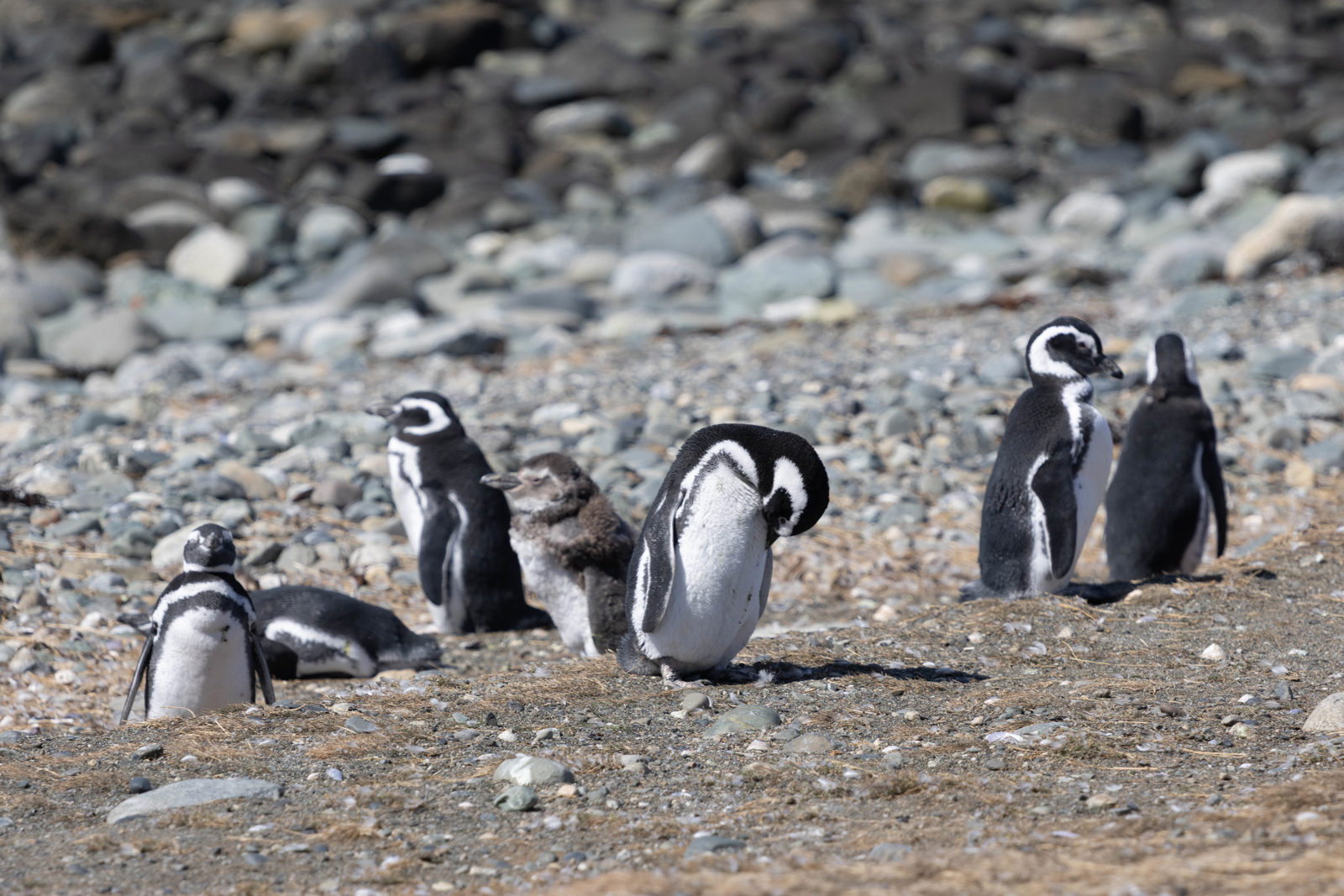
The visit to Isla Magdalena begins with a public ferry crossing from Punta Arenas, heading out across the Strait of Magellan towards one of Patagonia’s most important Magellanic penguin colonies. The journey takes around an hour and a half each way, with open water, distant coastline and seabirds adding to the sense of travelling into a wild part of southern Chile.
On arrival, visitors usually have around an hour on the island. A marked walking route leads through the colony, passing close to burrows, nesting areas and penguins moving between the shoreline and the open grassland. It is a short visit, but a memorable one, offering a close view of Magellanic penguins in their natural habitat before the ferry returns to Punta Arenas.
Magellanic penguins are among Patagonia’s most recognisable coastal birds, found along the shores of southern Argentina and Chile. Named after Ferdinand Magellan, these medium-sized penguins are well adapted to life in the cold waters of the South Atlantic and southern Pacific Oceans. Adults are easily identified by their black backs, white underparts and the distinctive double black band across the chest. Although ungainly on land, they are powerful swimmers, using their flipper-like wings to move quickly through the water in search of fish, squid and small crustaceans.
During the breeding season, large colonies gather along remote coastlines, grassy headlands and sheltered bays. Many pairs return to the same nesting sites year after year, digging burrows in soft soil or nesting beneath bushes for protection from predators and the Patagonian sun. The colonies are rarely quiet, filled with the braying calls of adults communicating with mates and chicks. Despite the dense gatherings, Magellanic penguins are highly skilled at recognising their own partner and offspring among thousands of birds.
Their annual cycle involves long migrations through southern South American waters. After breeding, many birds disperse northwards along the coasts of Argentina, Uruguay and Brazil before returning south for the next nesting season. Although still widespread, Magellanic penguins face increasing pressure from climate change, overfishing, oil pollution and habitat disturbance. Even so, seeing them emerge from the surf or walk across a windswept Patagonian beach remains one of the region’s most memorable wildlife experiences.
Content & Photo Gallery
A young Magellanic penguin standing at the entrance to its burrow on the Patagonian coast, waiting cautiously before making its way towards the shoreline.
An adult Magellanic penguin standing along the rocky Patagonian shoreline, pausing between journeys to and from the sea.
A resting Magellanic penguin shelters on the dry grassland above the Patagonian coast, its moulting feathers visible against the dry coastal terrain.
A juvenile Magellanic penguin moulting into its adult plumage, with patches of soft down still visible around the neck and back.
Two Magellanic penguins stand alert on the open Patagonian shoreline, their distinctive black-and-white markings clearly visible against the barren coastal landscape.